900 533 846

Commercial Support

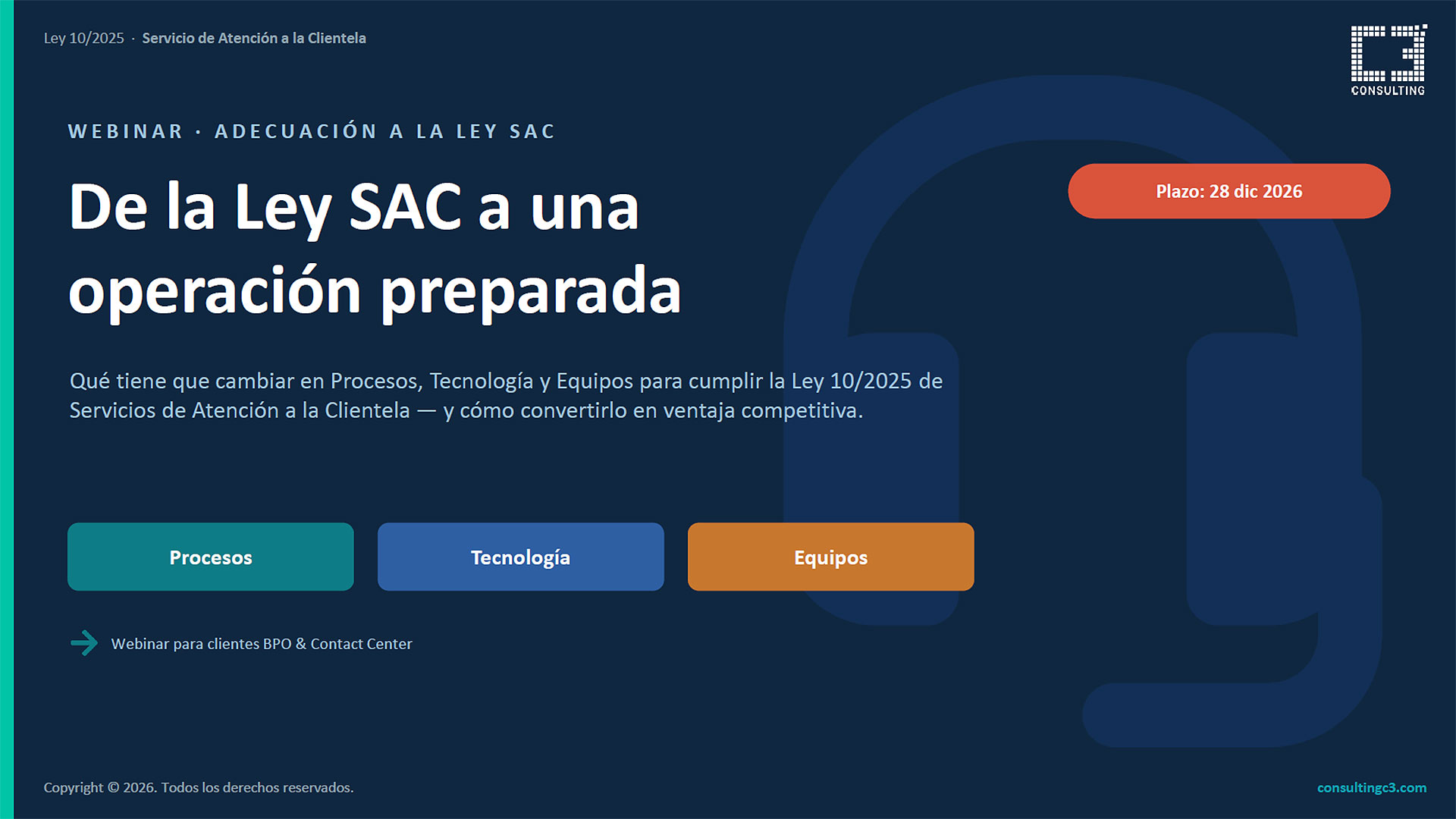
Webinar - SAC Law

The new regulations for Customer Service

Download the Practical Guide HERE (Spanish)

How to adapt the customer service and complaints model after the SAC Law.

Training Webinar

The Customer Service Law

Actual scope of application and regulatory specificities
ConsultingC3-caratula-webinar-Ley-SAC-formativo-2026
play-button

Questions and Answers

This document compiles all questions raised by attendees during the webinar and the answers provided by Patricia Guerrero, Operations Director at Consulting C3.

The answers reflect the interpretation of the SAC Law shared in the session. As some regulatory aspects are still under development, it is recommended to cross-reference them with each organization’s legal team and stay informed about updates from the AEERC and regulatory bodies.

Yes, that is correct. The SAC Law applies exclusively to B2C relationships, meaning companies that provide services to individuals who are end-users or consumers.

The law defines a client as a natural person who has a contract or has received a commercial offer from the company. Relationships between companies (B2B) fall outside the scope of this regulation.

No, in that case, it is not mandatory. The obligation to provide service in co-official languages applies only when the company provides service in the territory of the autonomous community where that language is co-official, or when it provides national service throughout the territory.

If a company operates exclusively in Madrid and its services do not extend to communities with co-official languages such as Catalonia, the Basque Country, or Galicia, it has no obligation to have operators who speak those languages.

However, if the company has a presence or provides service in communities with a co-official language, it must guarantee the possibility of serving clients who request it in those languages. If, at a specific moment, the necessary resource is not available, the client can be offered service in Castilian Spanish; and if the client prefers their language, a callback can be offered within the same business day.

Not necessarily. If the company does not provide an essential or basic service as defined by the SAC Law (water, gas, electricity, transport, or postal services), customer service hours only need to fall within the company’s business hours, without having to cover the opening hours of each individual establishment.

The only exception that would justify broader availability would be the existence of a risk of fraud or interruption of a basic supply. If these circumstances do not occur, general business hours are sufficient.

Yes, that is possible. The law allows that during hours when the customer service department is not operational, support can be channeled through the establishment itself (store, cafe, etc.).

However, there is an important condition: there must always be at least one available channel through which the client can access personalized service throughout the company’s business hours. That is, there cannot be any time slot within business hours during which the client is unable to be served by a person.

Yes, it still applies. The fact that the service is free or paid (onerous) is not the determining criterion for the application of the law. What determines whether a company is subject to the SAC Law are two factors:

  • The type of service: whether it is a basic service of general interest (water, gas, electricity, transport, messaging) or if the company does not provide that type of service but meets the size thresholds.
  • The size of the company: more than 250 employees, turnover exceeding 50 million euros, or total balance sheet exceeding 43 million euros.

Note: Therefore, a company may be obliged to comply with the SAC Law even if the specific service it provides to the user is free, provided that the above criteria are met.

Yes, absolutely. The SAC Law does not distinguish between paid and free services. What determines the obligation of compliance is the existence of a contractual relationship between the company and the user, even if that relationship does not involve any payment.

When a company makes a service available to a user, even if it is free of charge, a bond or commitment is established between both parties. That bond is sufficient for the company to be subject to the obligations established by law, provided that the size or service type criteria mentioned above are also met.

In summary: the free or paid nature of the service does not exempt from compliance with the SAC Law. The criterion is the existence of a contractual relationship and the company’s profile.

The answers compiled in this document are indicative and are based on the interpretation of the SAC Law carried out by Consulting C3 and MST. Some aspects of the regulations are subject to further regulatory development. It is recommended to consult with your own legal team and follow communications from the competent bodies to adapt each interpretation to the reality of each organization.

Consulting C3 | Business Strategy Consulting | Copyright © 2026 | All rights reserved.